Blogs
 7 mins read



For airline finance leaders, payment innovation creates value only when it is backed by confidence in cash receipts, financial exposure, and the cost of collection.
For an airline CFO, a payment approved at checkout is not the same as cash confirmed in the bank. Between the sale and the ledger, settlement differences, unexplained deductions, and disconnected records can leave finance unable to establish what has been collected and what remains outstanding. The financial consequence is uncertainty over receivables, cash availability, and the adjustments needed to close the books with confidence.
Accelya’s payment reconciliation capability indicates that up to 0.5% of sales can remain unmatched because of reconciliation breaks and unmatched settlements. That is not the same as a confirmed loss: some differences reflect timing or incomplete data, while others may reveal genuine shortfalls. But until those items are investigated, finance cannot reliably distinguish cash still in transit from amounts requiring recovery action. A small percentage can therefore conceal a material control issue.
Consider a European carrier generating US$178 in revenue per passenger. Assuming the 0.5% unmatched rate applies to that revenue value, it represents US$0.89 per passenger, or US$890,000 for every million passengers. That is not necessarily lost revenue, but it is value that finance needs to explain: what is awaiting settlement, what reflects a data discrepancy, and what requires recovery action.
Against an assumed net profit of US$7.76 per passenger, US$0.89 is equivalent to approximately 11.5% of profit per passenger. This comparison illustrates the scale of unresolved value, not a forecast profit uplift. Better control can help identify genuine shortfalls and prevent avoidable write-offs, but collecting an already-recognised receivable does not itself create new profit. Any net financial benefit depends on amounts actually recovered or losses prevented, the accounting treatment, and implementation and operating costs.
The investment case for payment reconciliation goes beyond reducing manual matching. It is about establishing what is due, confirming what has arrived, and assigning accountability for what remains unresolved. As airlines introduce more payment methods and acquirers, that discipline helps finance support growth without accepting greater uncertainty over cash, payment costs, and financial exposure.
Cash certainty requires a connected financial record
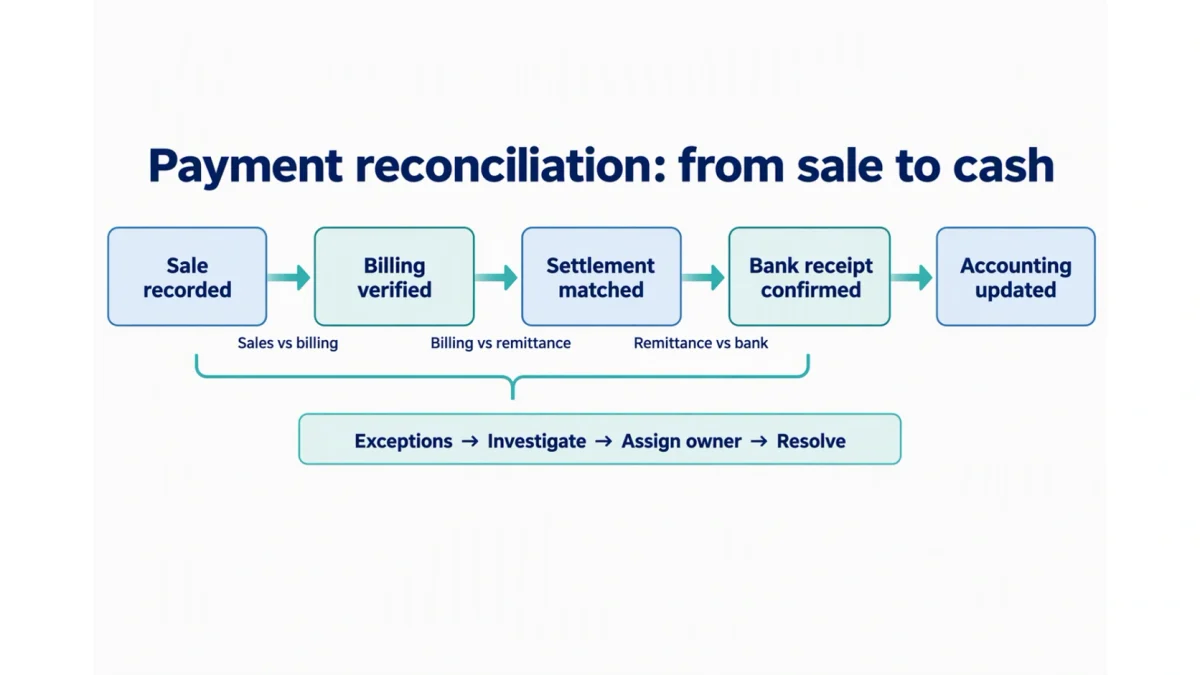
A sale may be recorded without matching billing evidence. A remittance may contain unexplained deductions. A settlement record may precede the corresponding bank receipt. These differences do not all represent missing cash, but they must be understood before finance can distinguish a normal timing difference from a shortfall that needs action.
For treasury, the distinction separates expected funds from confirmed receipts. For the financial controller, it determines whether receivable balances and adjustments can be supported at close. For the CFO, it establishes how much confidence to place in the reported cash and outstanding position. Separate, locally accurate views are not enough if the airline cannot connect them to the same transaction.
The control chain is straightforward: sales against billing, billing against remittance, and remittance against bank receipt, with the resulting position correctly reflected in accounting. Its purpose is not to suggest that all stages happen simultaneously. It is to show where a payment stands, explain differences, and direct unresolved items to the right owner.
A high match rate is not the same as financial control
A high matching percentage can coexist with material unresolved value. It says little about the size, age, or cause of exceptions, and an unmatched transaction is not automatically a loss. Timing differences, incomplete data, and genuine shortfalls require different responses. Treating them as a single backlog obscures the financial decisions that matter.
Finance leaders should therefore assess reconciliation through an exposure-and-resolution lens, alongside matching performance. A practical leadership scorecard would ask:
- Unresolved value: How much remains unexplained, and which items could represent a financial shortfall?
- Exception ageing: How long have items remained open, distinguishing expected settlement timing from overdue action?
- Resolution performance: Does each material exception have an owner, next action, and resolution timescale?
- Manual workload: Is investigation effort increasing with transaction volume, or is the process becoming more scalable?
Three airline experiences: governance, scale, and exposure
Accelya’s anonymized case summaries illustrate three distinct reasons for finance leaders to revisit reconciliation: evidence needed for audit, manual processes that struggle with growth, and financial exposure concealed by acceptable headline metrics.
| Airline example | Challenge | Reported outcome | Leadership lesson |
|---|---|---|---|
| European hybrid carrier | Payment governance gaps and difficulty validating receivables against cash receipts. | Stronger audit-ready controls and transaction traceability. | Financial confidence depends on evidence, not just process completion. |
| European carrier | Growth stretched a heavily manual process, with more than 70,000 manual reconciliations annually. | Settlement matching improved from below 50% to approximately 99%, according to Accelya’s internal case summary. | Transaction growth requires scalable controls, not proportionately more manual work. |
| Major North American carrier | Acceptable headline metrics masked material potential financial exposure. | Clearer visibility and more sustainable exception management. | Assess the financial significance of exceptions, not just aggregate matching performance. |
The common lesson is that the business case depends on the airline’s control gap, not a universal recovery percentage. These are case-specific reported outcomes, not industry benchmarks or guaranteed results. For a CFO, the relevant test is whether the proposed approach addresses the airline’s own governance, workload, and exposure priorities.
Payment economics need the same discipline as payment acceptance
Connecting settlement records, deductions, and fees across acquirers, markets, channels, and payment methods gives finance a stronger basis for understanding the cost of acceptance. It allows provider performance to be examined through financial outcomes, rather than approval rates alone.
Payment orchestration helps determine how a payment is processed; reconciliation establishes what happened financially afterwards. Connecting the two gives finance and commercial teams a common basis for evaluating payment choices. Better visibility does not itself guarantee savings, but it supports more informed decisions about processing costs and settlement performance.
Make financial control a condition of payment growth
Every new payment method or acquirer should come with a control plan before launch: transaction identifiers, settlement data, treatment of fees and refunds, bank matching, and ownership of exceptions. Otherwise, a simpler customer experience can create a more complicated finance process. The CFO’s role is not to restrict payment innovation, but to ensure its downstream obligations are understood and manageable.
This discipline must connect to revenue accounting while keeping recognition and collection distinct. Revenue accounting establishes what has been earned; payment reconciliation validates whether funds were billed, settled, and received. Linking the records supports a fuller financial picture without treating recognised revenue as evidence of cash collection.
Five questions for the finance investment agenda
- Can we distinguish expected receipts from confirmed cash across payment providers?
- Do we know the value, age, and cause of material unresolved items, not just the matching percentage?
- Can finance support balances and adjustments with traceable evidence at close?
- Can we compare payment costs and settlement outcomes across acquirers, channels, and markets?
- Can the control process accommodate new payment methods and growth without proportionately more manual work?
These questions turn a technology discussion into a finance investment decision. The case should start with the airline’s current unresolved value, investigation workload, and evidence gaps, then define the improvements it will measure. Any recovery or cost-saving assumption should be tied to that baseline, not borrowed from another airline’s results.
For the CFO, the objective is not a promise that every difference will disappear. It is confidence that cash receipts can be confirmed, financial exposure can be explained, and action can be assigned as the business evolves. Modern airline retailing expands the ways an airline earns revenue. Payment reconciliation provides the financial foundation to establish how that revenue becomes cash.
Take control of airline payment reconciliation
Discover how Accelya Payment Reconciliation can help your airline connect sales, settlements and cash receipts, identify exceptions, and improve financial visibility.



 Press Releases