
Accelya

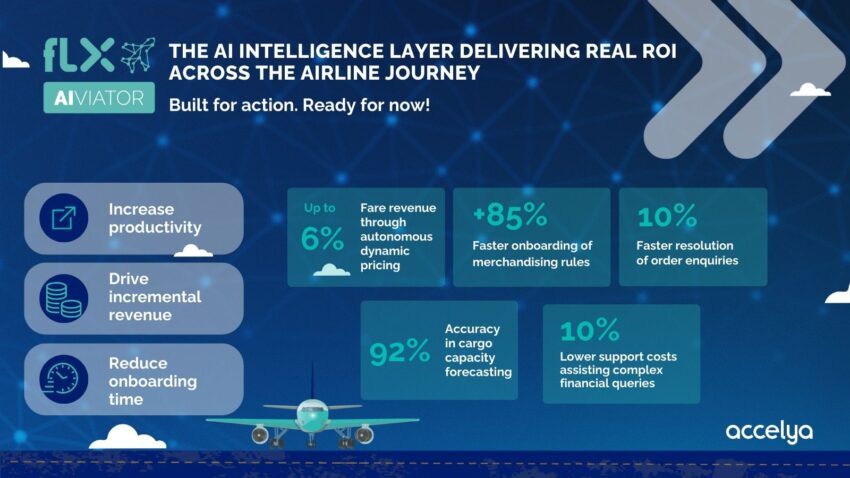
Powered by FLX AIViator

FLX Recover

Agentic AI execution for passenger recovery

Built on Amazon Bedrock AgentCore. Powered by FLX AIViator, Accelya’s AI intelligence layer, FLX Recover uses specialized AI agents to assess disruption, evaluate recovery options and coordinate action across airline systems. Recover passengers faster, reduce operational complexity and keep airlines firmly in control.

From disruption to resolution. Agentic AI · Powered by FLX AIViator

60,000

flights cancelled worldwide in August 2026

Disruption can trigger thousands of interconnected decisions across passengers, flights and operations.

85%

of passengers expect real-time updates on their phone

Passengers increasingly expect immediate, personalized responses throughout their journey.

Now

production-ready, after 18 months of rapid progress

Agentic AI can now reason across complex scenarios and coordinate actions in real time.

FLX Recover moves passenger recovery from recommendation to execution

Powered by FLX AIViator, Accelya’s AI intelligence layer, uses specialised AI agents to understand what has happened to each passenger, work out the best recovery and coordinate the actions needed to get their journey back on track.

AI INTELLIGENCE LAYER AGENTIC EXECUTION LAYER 1 2 3 4 5 Assess Prioritise Evaluate Care Communicate

Understands the journey

Uses passenger, Order and operational context to understand disruption impacts and individual recovery needs.

Reasons and coordinates

Evaluates recovery options and coordinates actions across systems as conditions evolve.

Keeps airlines in control

Operates within airline-defined policies, approval thresholds and human oversight.

HOW FLX RECOVER WORKS

Recover identifies the disruption, understands which passengers are affected and what each one needs, works out the best recovery option, coordinates the required actions and keeps the passenger informed.

01

Identify and classify disruption events as they occur.

02

Understand operational impact and individual passenger needs.

03

Evaluate recovery options and coordinate the best-fit actions across systems.

04

Deliver timely, personalized communications throughout recovery.

05

Capture outcomes to continuously improve future recovery decisions.

Every outcome feeds the next recovery decision.

PASSENGER-FIRST RECOVERY

Recover the journey, not just the seat

A disrupted passenger may not just need another flight. They may have a connection to protect, baggage to reroute, a paid seat or meal to rebook, assistance to arrange or compensation due..

Loyalty status

Group and family travel

Connections

Ancillary purchases

Special assistance requirements

Compensation obligations

FLX Recover looks at the whole journey and coordinates the right recovery for that passenger.

  1. Passenger
    Who is affected
  2. Order
    What they bought
  3. Communication
    What they are told
  4. Compensation
    What they are owed
  5. Resolution
    Journey recovered

BUSINESS OUTCOMES

Smarter recovery. Better outcomes.

01

Reduce the time from disruption to resolution.

02

Automate routine recovery and let teams focus on exceptions.

03

Take account of the whole journey, not just seat availability.

04

Apply airline rules consistently and keep visibility over decisions and actions.

POWERED BY FLX AIVIATOR

FLX Recover is powered by FLX AIViator, Accelya’s AI intelligence layer.

Built on Amazon Bedrock AgentCore and engineered with RapidScale to support secure, governed and scalable AI execution.

Agentic execution
AI intelligence layer
Secure, governed, scalable executionAmazon Bedrock AgentCoreEngineered with RapidScale

Secure

Enterprise-grade controls and governance.

Governed

Human oversight and airline-defined boundaries.

Scalable

Production-grade execution across airline workflows.

Transform recovery without replacing your technology

Work with the systems you already have

FLX Recover works with the airline’s existing technology. No major platform replacement required.

Integrates with

Passenger Service Systems

Order Management

CRM

Communications Platforms

Operational Systems

PSSOrderCRMCommsOps

INTRODUCING FLX RECOVER

A new approach to passenger recovery, powered by agentic AI

See how FLX Recover brings agentic AI to passenger recovery, coordinating decisions and actions across the journey while keeping airline policies, approvals and people firmly in control.

Detect in real time

Disruptions are identified and classified as they happen.

Recover in parallel

Agents work through every affected passenger at once.

Explain every decision

Every action is logged against one disruption ID.

Built on Amazon Bedrock AgentCore. Available through AWS Marketplace.

FAQs for FLX Recover

How is FLX Recover different from traditional disruption tools?

Traditional tools identify issues or recommend recovery options, often in batches. FLX Recover uses specialised AI agents that work in parallel to assess impact, reaccommodate passengers, coordinate communications and manage compensation in one continuous workflow.

Do we need to replace our PSS or operations systems?

No. FLX Recover is open and PSS-agnostic. It can run within FLX ONE or connect to your existing PSS, Order Management, CRM, communications and operational systems through open interfaces, using Accelya’s Modular Exchange Framework.

How much autonomy do the AI agents have?

As much as you decide. Your airline defines the policies, which scenarios run automatically, which require human approval and which limits can never be crossed. Every action is logged and reviewable.

How does FLX Recover relate to FLX AIViator?

FLX Recover is powered by FLX AIViator, Accelya’s AI intelligence layer. It extends FLX AIViator from AI that provides insight to agentic AI that coordinates and carries out complex airline workflows.

What technology is it built on?

FLX Recover is built on AWS using Amazon Bedrock AgentCore, which provides identity, observability and scalability for AI agents. It was engineered with RapidScale, an AWS Premier Tier Services Partner.

How do we measure success?

Typical measures include time to impact assessment, time to recovery, manual intervention rate, recovery acceptance, cost per disrupted passenger, compensation exposure, ancillary value protected, post-disruption satisfaction and audit completeness.

Recover passengers faster, improve consistency, and orchestrate disruption management across your existing technology environment.

Request a Consultation