Blogs
Blogs
 5 mins read


There has been a lot of discussion recently about NDC, airline control and the future of Modern Airline Retailing.
Recent moves in the market have raised a legitimate question: can airlines scale Modern Airline Retailing without consolidating onto a single incumbent technology platform?
At Accelya, we believe the answer is yes — and the evidence matters more than the narrative.
The airline industry has spent decades learning the limitations of dependence on large, consolidated technology environments. These environments can bring consistency, but they can also slow innovation, limit differentiation and make it harder to respond to changing customer expectations.
Airlines that have taken greater control of their digital channels, websites and NDC programs are consistently delivering capabilities that are difficult to replicate through traditional environments alone. Continuous pricing, dynamic bundling, rich content and omnichannel servicing have become increasingly important sources of competitive differentiation.
NDC was never simply about creating another booking channel. It was created to provide the foundation for a more flexible and airline-controlled retailing future.
Across the Accelya platform, we support more than 20 innovative airlines and process approximately 50% of global NDC bookings. The results demonstrate that Modern Airline Retailing is moving beyond technical connectivity into measurable commercial impact. Travel Management Company bookings have grown by 169% over the last 12 months, while NDC transactions distributed through GDS channels have also increased by 169% over the same period. Individual airline programs are achieving up to 30% ancillary attachment, up to $12 in incremental revenue per ticket and millions of dollars in potential EDIFACT savings as more volume shifts to modern retailing channels.
Lufthansa Group is one of many pioneering Accelya customers demonstrating how airline-led retailing can scale while delivering measurable commercial impact. Today, more than 50% of Lufthansa Group’s indirect sales flow through NDC-enabled channels, while ancillary attachment rates are up to three times higher through NDC than through traditional channels. These outcomes demonstrate that Modern Airline Retailing is no longer a future vision, but a commercial reality delivering measurable results at scale.
These results matter because they show what the next phase of Modern Airline Retailing is really about. Not ideology. Not architecture for its own sake. Not a binary choice between fragmented best-of-breed complexity and single-stack dependency. The next phase is about helping airlines scale retailing capabilities in ways that preserve control while delivering real commercial outcomes.
NDC remains a foundational layer of this transformation. Its original promise was to give airlines greater control over offers, distribution and customer experience through open, standardized APIs. As the industry continues its transition toward Modern Airline Retailing, that promise is more relevant than ever.
The next challenge is not adoption alone. It is transformation.
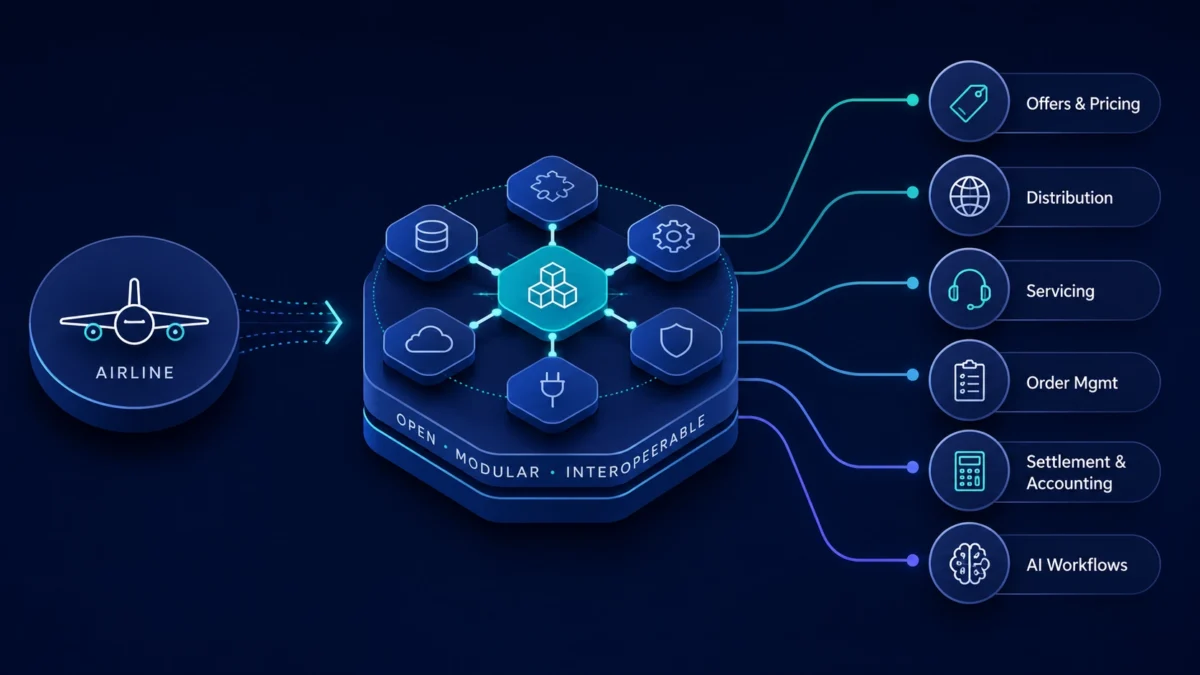
The industry has made significant progress with NDC. Yet adoption by itself does not create a modern retailer. Airlines now need to scale retailing capability across commercial, operational and financial processes: from offer creation and dynamic pricing to servicing, order management, settlement, accounting and future AI-enabled workflows.
Modern retailing will only succeed if it works beyond shopping and booking. Airlines, sellers and technology partners need to support changes, disruption, servicing, settlement, accounting and post-booking operations with the same reliability as the initial offer and order. That is where open standards, interoperability and implementation discipline become critical.
No single system can realistically deliver every capability every airline will need. The world’s most sophisticated digital retailers operate interconnected ecosystems of specialized capabilities that evolve as customer expectations, data signals and market conditions change.
There is no single roadmap for this journey. Every airline is progressing at a different pace, shaped by its commercial strategy, technology environment, channel mix and transformation priorities. For many airlines, transforming the indirect channel through NDC is the logical first step: creating a stronger omnichannel foundation for modern retailing. Others are already looking across the broader Offer and Order journey, or prioritizing specific capabilities such as offer optimization, dynamic pricing, order accounting or AI-enabled servicing.
That is precisely why flexibility matters.
Modern Airline Retailing is a journey, not a one-size-fits-all platform decision. Airlines that are serious about Modern Airline Retailing need technology partners and capabilities that can adapt to their strategy, work with existing investments, collaborate across the ecosystem and support continuous innovation without forcing unnecessary compromise.
AI will increase the value of open ecosystems
As AI and agentic commerce continue to evolve, some have suggested that industry standards may become less important.
AI changes how systems interact. It does not eliminate the need for common data models, trusted connectivity, consistent servicing and interoperable ecosystems. In many ways, AI increases the value of openness rather than reducing it.
The future of airline retailing will become more intelligent, automated and personalized. But it will still depend on the ability of participants across the ecosystem to work together through open standards and interoperable platforms.
Why openness matters
Airlines are right to demand more standardization, resilience and serviceability from Modern Airline Retailing. Fragmented implementations create cost, complexity and friction across the ecosystem.
But standardization should not require surrender.
Standardization and consolidation are not the same thing. Airlines need greater consistency, resilience and interoperability across the retailing ecosystem. That does not automatically require dependence on a single platform, provider or technology stack.
The answer to fragmentation should not be another generation of dependency. Airlines need technology partners that can work with existing investments, collaborate across the ecosystem and support continuous innovation without constraining future choice.
That is why interoperability and modularity are strategic requirements, not technical preferences.
Open standards such as NDC provide the foundation. Interoperability enables the ecosystem to work together. Modularity gives airlines the freedom to adopt the capabilities that create the greatest value, at the pace that makes sense for their business.
The future of Modern Airline Retailing should be standardized enough to scale, open enough to preserve choice and flexible enough to keep airlines in control of their commercial future.
The next phase will be won by airlines that can combine control with scale: standardized enough to operate, open enough to evolve, and flexible enough to keep innovation airline-led.

 Press Releases

 Videos
 Whitepapers