Blogs
 8 mins read



This article is based on an episode of TIMcast, the monthly podcast from Travel in Motion, recorded in October 2026. In it, Philip Fernandes, SVP – Product Management of Accelya discussed how airline finance is changing as the industry moves to offers and orders, and why payment reconciliation is becoming central to that shift.
A modern order is not proof of collected cash
An airline can modernize how it sells and still struggle to prove what it has collected. Moving from tickets to orders does not automatically close that gap. It changes the records, processes and relationships through which finance must establish the answer.
That is the financial control challenge behind Modern Airline Retailing. An order shows what the customer bought. It does not, on its own, establish whether the right amount was billed, which adjustments followed or what ultimately reached the airline’s bank account. Those connections have to be maintained throughout the order’s life.
In his October 2026 TIMcast conversation, Philip Fernandes, SVP – Product Management at Accelya, describes payment’s more explicit place in the airline retailing architecture as a turning point. The implication for finance leaders is clear: retailing readiness should be judged not only by an airline’s ability to create and service an order, but by its ability to explain the money behind it.
The order changes. The payment trail must keep up.
In the ticket and EMD world, the sale, payment and accounting record often follow separate paths, meeting again during reconciliation. An order-based model brings payment more closely into the lifecycle of the purchase: creation, changes and cancellation can each carry a financial consequence.
“Payment is already becoming much more tightly linked to the order life cycle,” Philip says. The important word is lifecycle. Linking a payment to the original sale is only the starting point; finance also needs to follow what happens when that sale changes.
The opportunity is not simply faster matching. It is a more connected view of the customer transaction and its financial outcome:
- Visibility: understanding the payment status of an order without waiting to reconstruct it from a later batch.
- Service: supporting refunds, changes and disruption handling with a payment trail connected to the order.
- Control: identifying differences between what should be collected and what has been received while there is still time to investigate.
Sold, billed, collected: three states, not one
A successful sale, an accurate bill and a completed collection are different events. Treating them as one obscures the very gaps finance needs to see.
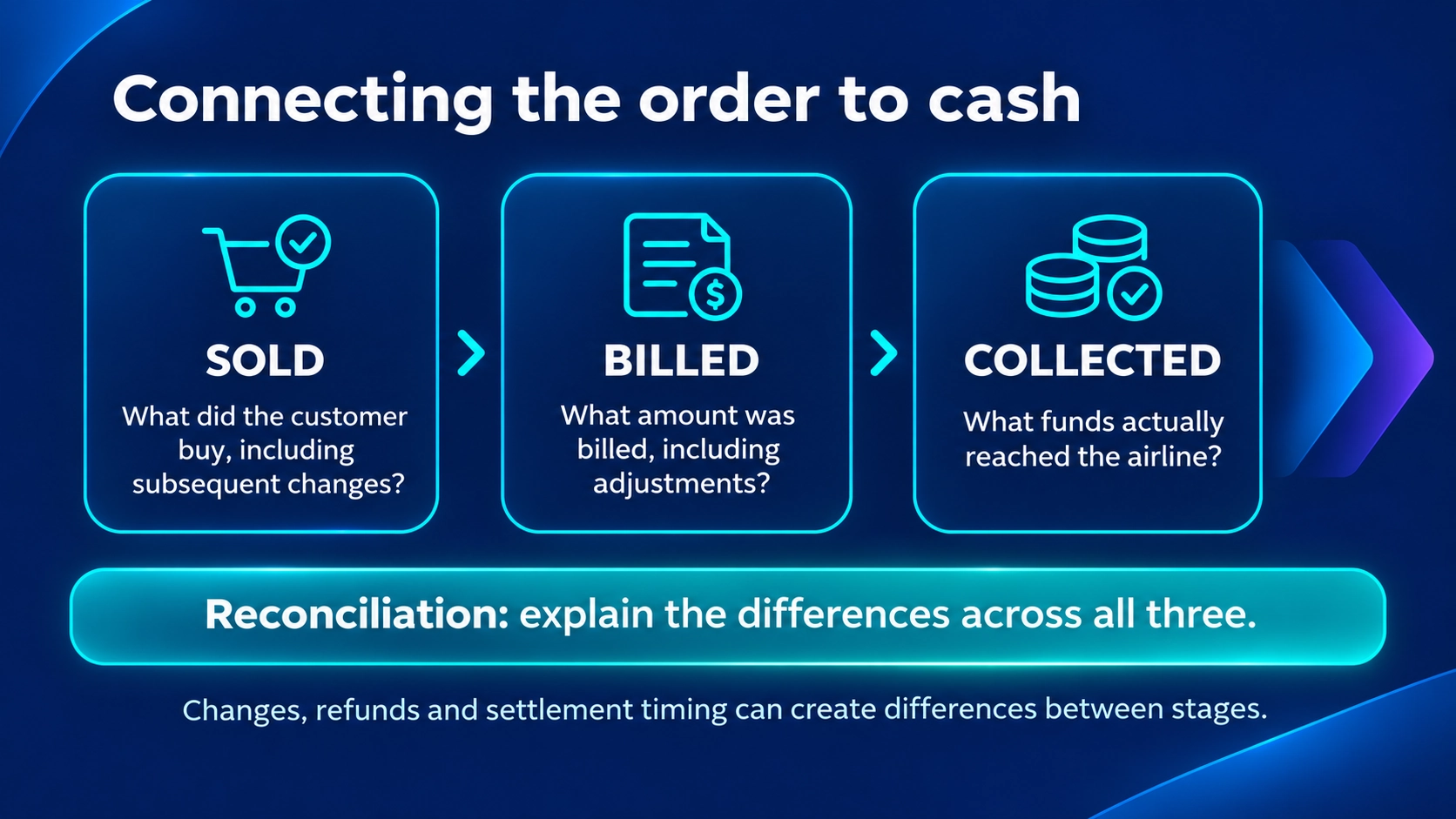
Philip’s argument is that airlines need control across all three, with each stage connected to the next. The question is not just whether a payment was processed. It is whether the airline can establish what it was owed, what was billed and what was collected, and explain any difference.
Where those links are rebuilt manually each settlement cycle, more order events and payment participants mean more work to reconstruct the same financial story. Reconciliation therefore belongs in the design of the order flow, not only in the processes that follow it.
Transactions move in real time; money still moves on bank time
The hardest distinction is between knowing that something happened and knowing that the money arrived. Philip describes Accelya’s order accounting platform as designed for real-time operation, with separate transaction-processing and payment tracks that can send information to parties such as IATA, ARC and acquirers as events happen.
That does not make every settlement real time. Banks and settlement intermediaries still determine when funds reach the airline. Faster information and faster cash are related goals, but they are not the same capability.
During the transition, finance must bridge two clocks: order events that can be available immediately, and funds that arrive later, sometimes netted or reduced by fees. Reconciliation connects them. Without it, a real-time view of orders can still leave an incomplete view of cash.
Philip expects settlement to move towards daily cycles over time. That remains a direction of travel, not a universal operating reality. The immediate priority is to distinguish money that is not yet due from money that is overdue, unmatched or disputed.
More ways to pay mean more obligations to explain
The challenge extends beyond connecting two systems. Each payment method, intermediary and regulatory obligation adds conditions that finance must accommodate. Philip highlights four areas:
- Payment diversity. Cards, UATP, BSP and ARC collections already create different reconciliation requirements. Mobile and alternative payments, and, Philip notes, cryptocurrency in some markets, add their own settlement timings, fees and data formats.
- Fraud controls. Controls established around ticket sales need to be carried into the order flow and verified, rather than assumed to transfer automatically.
- Tax. Bundling flights, ancillaries and third-party services makes it important to preserve the financial detail behind the total order value.
- Invoicing regulation. E-invoicing and country-specific requirements make the audit trail part of the design challenge, alongside payment processing and settlement.
These are not all problems reconciliation can solve on its own. They do, however, shape what a complete financial explanation must contain. A bank receipt is the endpoint of that explanation, not a substitute for it.
The real test is the exception, not the original sale
Proofs of concept demonstrate progress, but production readiness depends on what happens beyond a straightforward purchase. Philip identifies three areas where standards, processes and financial control need to advance together:
- BSP settlement for orders. Settlement with Orders needs to support the collection of money for orders sold through agents, connecting the new retailing model to the settlement processes behind it.
- Deterministic interline settlement. Defining standards is only part of the task. The processes that establish and settle obligations between airlines must work consistently with them.
- Disruption. Cancellations, re-bookings, involuntary changes and refunds test whether the financial trail remains intact after the original order has changed.
These are broader industry challenges, not simply matching problems. Their shared financial test is nevertheless straightforward: after every adjustment and transfer between parties, can the airline explain what it is owed and demonstrate what it received?
AI must strengthen control, not bypass it
Matching, exception handling and variance investigation are natural areas to consider AI as order activity grows. But automation does not remove the need to control how sensitive financial and passenger data is used.
“A lot depends upon how we architect it,” Philip says. He contrasts the scrutiny surrounding AI with established industry exchanges such as TCN and ISR files, which already carry personal information between parties. Familiarity with those exchanges should not be mistaken for assurance; both existing processes and new AI applications need appropriate governance.
Philip describes Accelya’s approach as a tiered architecture that controls data movement and segregates personal information from downstream AI. That is an architectural approach to managing exposure, not a reason to dismiss the risk. For finance, the objective remains the same: use automation to support reconciliation without weakening the controls around the data it relies on.
Five questions that reveal the control gap
The transition will not happen in one step. Finance must be prepared to reconcile PNRs, tickets, EMDs and orders alongside one another. These five questions provide a practical way to assess whether financial control is keeping pace with retailing change:
| Control test | The question leaders should ask | What a strong answer demonstrates |
|---|---|---|
| Traceability | Can we follow a sale through billing to collection? | A connected record, including adjustments and unresolved gaps. |
| Exception visibility | How quickly can we explain a difference? | Visibility of exceptions and the time needed to resolve them. Real-time order data alone does not eliminate reconciliation lag. |
| Settlement clarity | Can we explain a net receipt at transaction level? | Fees, chargebacks and short payments are separately identifiable, rather than hidden inside an aggregate receipt. |
| Payment scalability | Can new payment partners join the same control framework? | Growth without a separate manual reconciliation process for every acquirer, wallet or alternative payment method. |
| AI governance | Can we show how data is protected before applying AI? | Defined model access controls and segregation of personal information. |
Production readiness must include financial readiness
In the October 2026 conversation, Philip said Accelya had strong airline engagement and multiple proofs of concept under way, and was targeting large-scale order accounting production by the end of the first quarter of 2027, with most core cases tested at volume. That is a forward-looking milestone, not a statement that production has already been achieved.
The broader lesson extends beyond any one platform or launch date. Creating and servicing orders demonstrates retailing capability. Connecting those orders to billing, settlement and cash demonstrates financial control. A credible transformation needs both.
Sold, billed, collected. The test is not whether every order produces instant cash. It is whether the airline can explain, at each stage, what it expects to receive, what it has received and why the two differ.
This article is adapted from Philip’s conversation on TIMcast, the monthly podcast from Travel in Motion. To learn how Accelya Payment Reconciliation and Order Accounting help airlines connect every sale to cash, contact our team.
Ready to turn Modern Airline Retailing into measurable value?
Discover how Accelya can help your airline unlock new revenue opportunities, improve efficiency and modernise at your own pace.



 Press Releases