Blogs
Blogs
 4 mins read


I started my career in airlines. The one thing I took away from that time — other than a deep appreciation for any airline who manages to make money in that business — is that practically every world event conspires to chip away at margins that were already slim.
Fuel costs, currency swings, a volcano, a pandemic, tariffs and conflicts: the list of things that can wreck an airline P&L is essentially infinite. Which means that the way an airline sells its product — the cost, the control, the flexibility — matters so much. Margin is hard enough to find without giving it away through your distribution strategy.
Freedom and flexibility differentiates successful innovation from stale status quo, it’s extremely valuable, which is why legacy players work so hard to prevent their airline partners from having it, fiercely protecting their cash cows by seeking contractual distribution commitments that airlines may not understand the detrimental impact of signing up to.
That’s ultimately what drew me to Accelya, and to NDC.
NDC is real — and it’s delivering
I’ll admit I was skeptical early on. I understood why the legacy GDS model frustrated airlines, but I also saw the complexity of unpicking it. Some high-conviction carriers took the bull by the horns anyway and evolved a model that had no desire to evolve of its own accord.
The results speak for themselves: NDC isn’t pioneering anymore, it’s standard, with some airlines now pushing 60-80% of their indirect volume through it — versus the 10-15% typical of PSS-led NDC. And the servicing capabilities have matured to the point where my former TMC employer is a genuine pioneer, proving it works as well for a business trip to Frankfurt as for a week’s sun and sangria in Torremolinos.
The conundrum of competing incentives – for some
Before I joined Accelya, I was genuinely uncertain where an airline would even start. What became clear quickly is that the choice of technology partner is the critical variable — and it’s where most NDC programs quietly stall.
Some of the companies airlines rely on to build their NDC capabilities also operate large legacy distribution businesses. As airlines and the wider industry push the transition from EDIFACT to NDC, these providers must balance that shift with distribution models built around legacy technology and commercial structures.
In practice, this can influence how NDC content is distributed. If that content is routed primarily through existing GDS networks, the economics may be less attractive than other options, such as direct connects or new third-party aggregators. It may also reduce the airline’s ability to exercise full control over how and where its content is distributed, limiting some of the flexibility and commercial choice that NDC was designed to enable.
As a result, airlines may not fully capture the cost, control and commercial benefits that made NDC attractive in the first place.
Accelya’s approach is airline-first, which makes us unique in this space, and is a contributing factor to explain why we’re able to drive better outcomes than others.
FLX Select — from theory to tangible ROI, easy and fast
Accelya drives more NDC volume than everyone else put together. The team took that experience and built it into an end-to-end solution called FLX Select: everything an airline needs to generate positive ROI from NDC, the industry’s simplest and fastest path from legacy distribution to NDC success, , with the option to expand capabilities as the airline strategy develops.
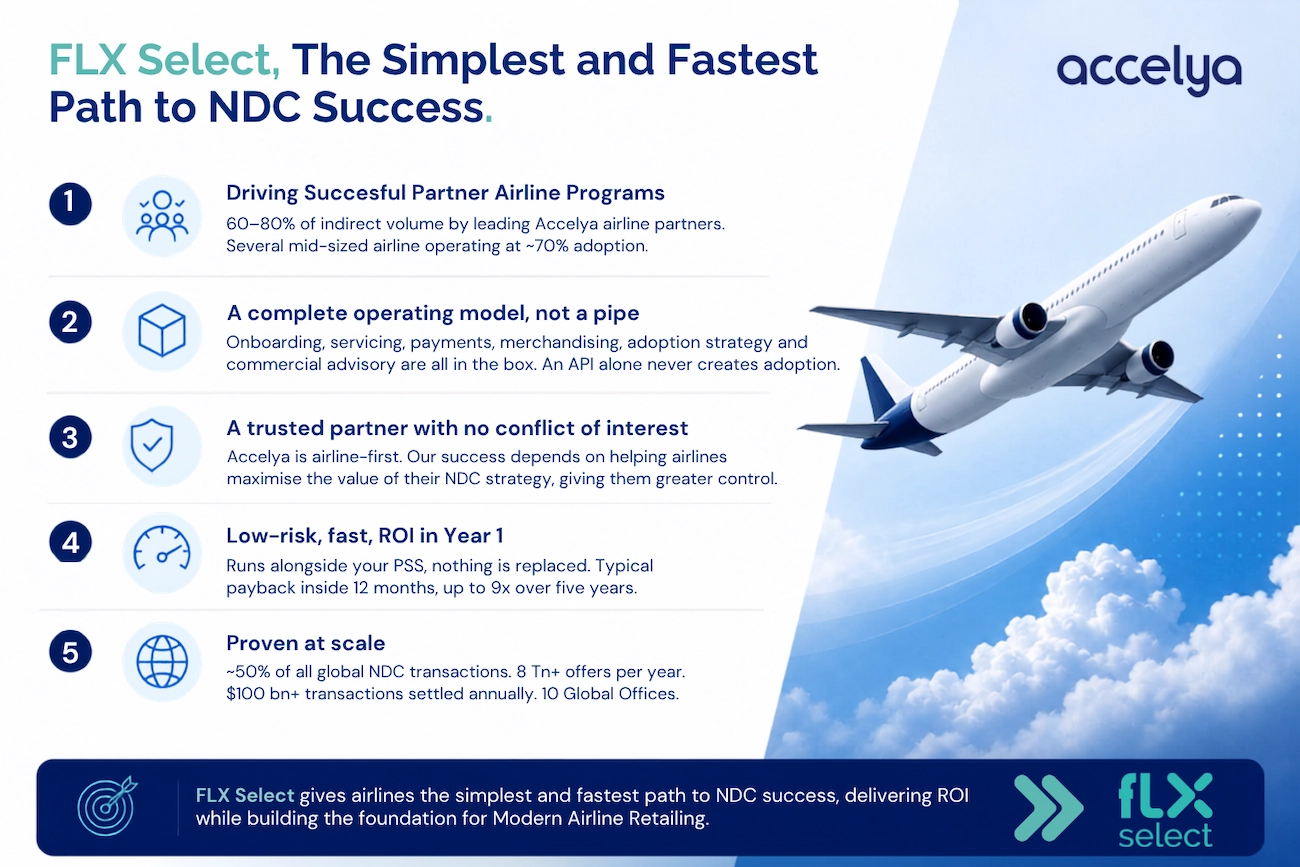
It’s a complete operating model, not just a pipe that airlines have to make work themselves somehow. Onboarding, servicing, payments, commercial advisory, agent adoption — all in the box. This is because an API alone never creates adoption, and everything in the box with FLX Select is designed to minimize the technical workload for airlines, enabling them to focus on what they’re good at, their retailing, merchandising and commercial strategy. It’s not a major upheaval for the airline, the NDC program runs alongside GDS distribution and synchs with the airline’s existing PSS — nothing is replaced, nothing is switched off.
Payback is typically inside 12 months, with returns up to 9x over five years. Several airlines we work with – mid-sized carriers with small distribution teams— are at approximately 70% NDC adoption. Across the platform, Accelya processes over 8 trillion offers per year.
FLX Select is the fastest speed to market of NDC in the industry, from a technology partner whose commercial incentives are exactly aligned to yours – making your NDC as successful as your strategy demands.
That’s the conversation I’m looking forward to having.


 Whitepapers

 Press Releases