Blogs
Blogs
 4 mins read


I’ve been involved with a number of airline NDC API developments over the past several years — and before that, a range of airline direct connect API projects. Along the way, I’ve learned a lot about what makes NDC programs succeed… and what causes them to stall.
In the spirit of David Letterman’s Top 10 List (one of my old favorites), here’s my take on the Top 10 Reasons why nearly half of airline NDC programs fail to either get off the ground or achieve meaningful scale.
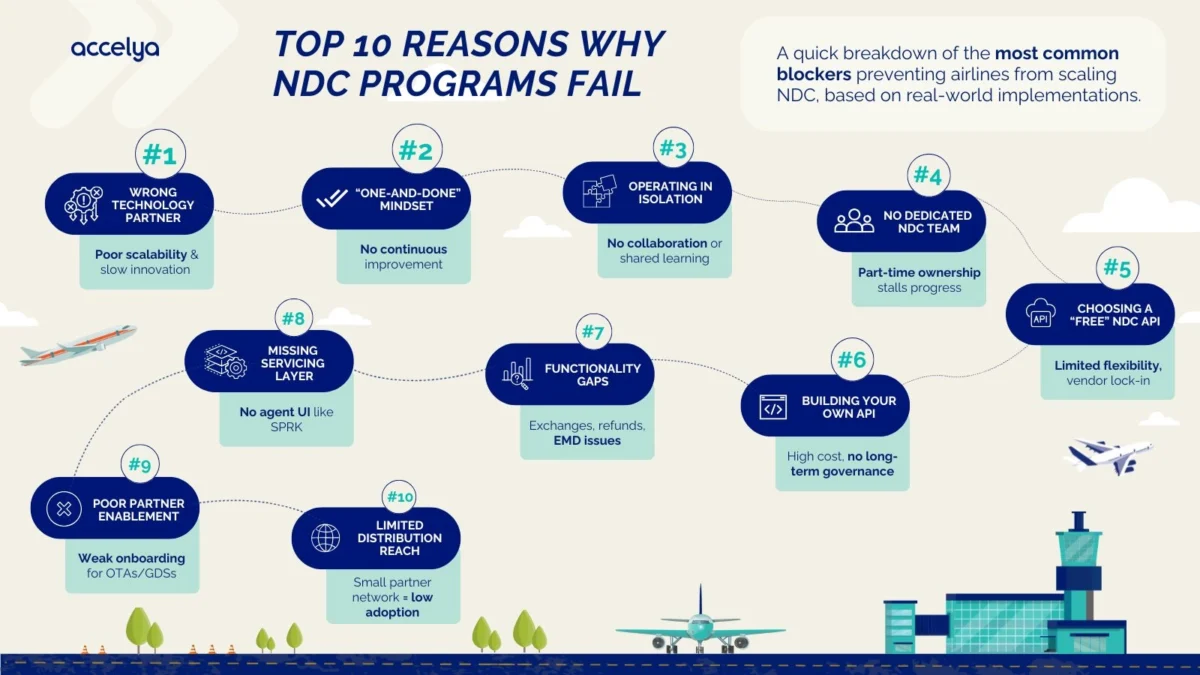
Reason #10: Limited distribution reach
The airline doesn’t have an established network of qualified, capable distribution partners to tap into for NDC adoption. Without those partnerships, even the best API can sit idle.
Reason #9: Insufficient partner enablement and support
The airline lacks an internal or external technical and functional support arm to help OTAs, consolidators, GDSs, and aggregators connect. Not every distribution partner understands NDC workflows — proactive guidance makes a world of difference.
Reason #8: Missing core booking and servicing capability
Many NDC programs underestimate the need for a robust booking and servicing platform, such as SPRK, to complement their API. Even the most advanced NDC API needs a user-facing layer where agents and partners can search, book, service, and troubleshoot in real time. Without it, adoption is slow and servicing becomes painful.
Reason #7: Functionality gaps beyond “search, book, ticket”
Basic NDC functions are now table stakes. The real challenge — and the real cost — lies in getting post-ticketing processes to scale. Exchange, refund, EMD, disruption handling… these are where most NDC implementations hit turbulence.
Reason #6: Building your own NDC API without a long-term plan
Some airlines choose to build their own API internally. It can work — but only with clear governance, investment discipline, and a plan for ongoing evolution. Otherwise, the result can be a “money pit” of recurring spend with little return. I once told an airline CEO we could rebuild and manage their NDC API for less than 15% of their annual cost. His reply: “What am I supposed to do about that now?” He’s no longer a CEO. Good intentions, but beware of building an albatross.
Reason #5: Accepting a “free” or “nearly free” NDC API
When your PSS provider offers a free or heavily discounted NDC API, read the fine print. You’ll likely end up with a cookie-cutter solution, limited flexibility for enhancements, and a long-term dependency that stifles innovation. You usually get what you pay for.
Reason #4: No dedicated NDC team
Too many airlines assign NDC oversight to part-time staff juggling other priorities. A successful program requires executive commitment, ownership, and a focused, cross-functional team accountable for results.
Reason #3: Operating in isolation
Without access to an NDC user group or peer forum, airlines miss out on shared learning. Regular collaboration across carriers can prevent costly missteps and accelerate solutions — while still respecting competitive boundaries.
Reason #2: Treating NDC as a one-and-done project
An NDC API is never “finished.” Continuous business and technical development is essential to keep pace with evolving standards, partner needs, and servicing realities. Airlines that underinvest post-launch see adoption plateau quickly.
Reason #1: Picking the wrong technology partner
This is the big one. Your NDC technology partner isn’t just a vendor — it’s a long-term collaborator in your retailing journey. You’ll share ideas, innovations, wins, and challenges over years. Choose a partner that can scale with you, challenge you, and innovate alongside you.
A Final Thought
A great NDC program is equal parts technology, governance, and collaboration. The airlines that succeed don’t just publish APIs — they build ecosystems so pick wisely!


 Whitepapers
 Press Releases

 eBooks