Blogs
Blogs
 7 mins read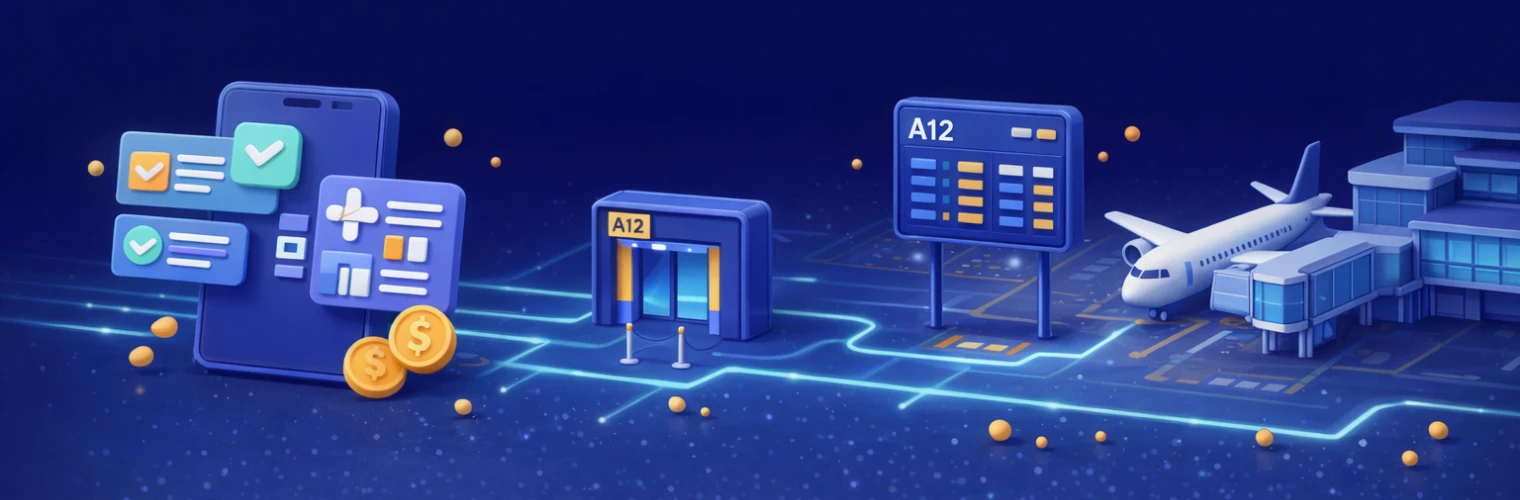


FLX ONE Delivery: The modern, interoperable path from order creation to airport execution
Modern Airline Retailing has moved quickly over the last few years.
Across the industry, the conversation has focused on Offers and Orders: how airlines create more relevant products, price more dynamically, personalize bundles, and move away from legacy retailing models toward a more flexible, order-centric future.
That focus is right. It is where the retailing opportunity begins; it is not where the customer experience ends. The promise made at booking still has to be kept at the airport.
A dynamically priced bundle, a paid seat, a loyalty benefit, a baggage entitlement, a disruption option, or a premium service only becomes real when it is recognized and delivered through the airport journey. Check-in, bag drop, lounge access, boarding, disruption handling, and service recovery are where modern retailing either becomes operational reality or breaks down.
That is why Delivery matters.
Accelya powers ~50% of global NDC transaction volumes today. That gives us a clear view of how Modern Airline Retailing is scaling, and where the next challenges are emerging. One of those challenges is increasingly clear: Offers and Orders are only part of the transformation. If the airport cannot recognize, fulfil, and update what was sold, the retailing promise remains incomplete.
The gap between the order and the airport
Imagine a frequent flyer who books a premium bundle online. The order includes priority boarding, extra baggage, lounge access, and a paid seat.
Everything is confirmed at booking.
At the airport, the agent cannot see the full entitlement clearly. The bag allowance does not display correctly. Priority boarding is not recognized. A supervisor is called. A queue builds. The passenger loses confidence. The airline loses the value of the experience it sold.
The offer was not the problem. The order was not the problem. The gap was Delivery.
This is the challenge many airlines face today. Legacy Departure Control Systems were built for a different era. They were designed around fragmented Passenger Name Records, tickets and EMDs that decentered the customer experience in favor of operational control.
Those systems remain operationally critical. They were not designed to deliver dynamic bundles, personalized ancillaries, contextual service recovery, and real-time order updates across a fragmented airport environment with integrity.
The result is familiar across the industry: duplicated logic, inconsistent passenger records, limited visibility between commercial and operational systems, and frontline teams forced to work around technology rather than being fully enabled by it.
A modern bridge to airport delivery
FLX ONE Delivery was built to connect the order-centric world of Modern Airline Retailing with the operational reality of the airport.
It is designed to ensure that the products and services sold during booking can be recognized, fulfilled, and managed across the airport journey. That includes passenger status, service entitlements, ancillary purchases, disruption options, fulfilment status, and the operational data needed by airport teams and partners.
This requires more than a new application layer. Airport delivery is mission-critical. It depends on resilience, latency, integration, regulatory compliance, and operational trust. Airlines cannot afford a theoretical architecture that works in a demo but struggles in a live airport environment at peak departure time.
That is why FLX ONE Delivery combines modern retailing architecture with proven operational foundations.
Through Accelya’s partnership with DXC Technology, FLX ONE Delivery builds on deep Departure Control System (DCS) expertise and proven capabilities used across complex airport environments. Through integration with SITA’s airport ecosystem, it connects modern retailing and order orchestration with the broader airport environment, including passenger admissibility and acceptance, and real-time airport services. Through Accelya’s cloud-native architecture on AWS, it is built for resilience, global scale, and continuous innovation.
The result is a modern bridge between digital retailing and airport execution: cloud-native, order-centric, and grounded in the operational experience airlines need when departure performance is on the line.
Modernization without rip and replace
The biggest barrier to airport delivery transformation is not ambition. Airlines understand the need. The barrier is risk.
DCS environments are deeply embedded. Airport processes are operationally sensitive. Contracts are long. Every airport has its own complexity. Every airline has a different technology landscape. No serious airline wants to gamble the departure operation on a theoretical future-state architecture.
Airlines are right to be cautious. Modernizing Delivery does not have to mean taking a high-risk leap.
FLX ONE Delivery is designed around a practical principle: airlines should not have to rip out what works in order to introduce what is better.
Airlines can introduce Accelya’s order orchestration capabilities alongside existing PSS and DCS environments, including legacy and third-party stacks. Through open APIs and the Modern Exchange Framework aligned with IATA standards, FLX ONE Delivery enables order-centric processing and modernized delivery workflows while allowing airlines to transition at a pace that reflects their operational reality.
That means existing systems can continue to operate where needed, while Accelya provides the orchestration layer that connects order information with airport execution.
This is what interoperability means in practice: a credible and staged path from today’s operating environment to tomorrow’s order-centric model.
Three practical paths forward
No two airlines are starting from the same place. FLX ONE Delivery is designed to support different transformation paths.
Airlines can modernize Offers and Orders while retaining their existing DCS, with Accelya’s orchestration layer keeping passenger status, flight operations, service entitlements, and fulfilment information synchronized across both environments.
They can introduce FLX ONE Delivery alongside an existing order management, PSS, or hybrid stack, using Accelya as the execution layer for airport fulfilment while preserving upstream commercial systems.
Or they can move toward a broader end-to-end transformation, connecting offer creation, order management, and airport delivery step by step, airport by airport, and capability by capability.
The aim is to avoid a high-risk big bang and support a controlled, pragmatic migration toward a modern retailing environment where the offer, the order, and the airport experience are connected.
From promise to performance
Modern Airline Retailing will not be judged only by the sophistication of the offer.
It will be judged by whether the airline can deliver what was promised.
That is why Delivery is becoming one of the most important parts of the transformation. It connects commercial intent with operational execution. It turns the order into the airport experience. It helps airlines protect ancillary revenue, improve service consistency, support frontline teams, and give travelers confidence that what they bought is what they will receive.
FLX ONE Delivery brings together Accelya’s leadership in Modern Airline Retailing, DXC Technology’s proven DCS expertise, SITA’s airport ecosystem, and AWS cloud-native scale to give airlines a practical, interoperable path to modern airport delivery.
The promise is made at booking. It is kept at the airport.
FLX ONE Delivery helps airlines get there step by step, connecting modern retailing to airport execution without a high-risk big bang.

 Press Releases


 Videos