Blogs
Blogs
 4 mins read


Operational excellence is the real competitive advantage in air cargo.
Airlines talk about improving on-time performance, increasing throughput, reducing operational friction and responding faster to disruption. Yet many cargo businesses have invested heavily in technology and still struggle to achieve these outcomes consistently.
The issue is rarely the amount of technology in place.
More often, it’s how those systems are designed and connected.
Operational excellence in cargo highly depends on the amount of structural constraints created by legacy technology architectures. When systems are rigid and fragmented, they affect the quality and speed of decision-making, create waste and manual work, and make it harder to respond when conditions change.
The consequences are familiar across the industry: missed SLAs, underutilized capacity, operational workarounds, and overall deterioration of customer satisfaction.
We have observed that the airlines that succeed tend to follow three technological fundamentals.
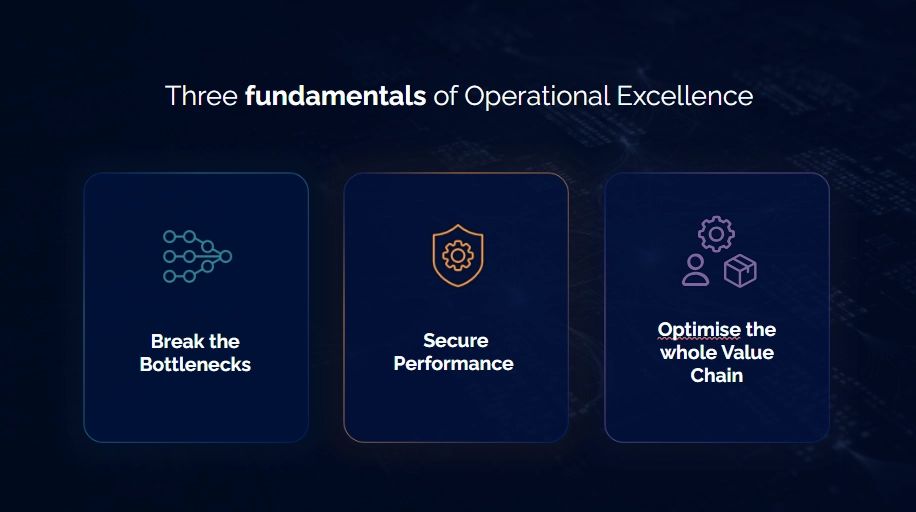
1. Replace bottlenecks with open, modular architecture
Many cargo platforms were designed as monolithic systems built for stability in a different era.
Over time, these architectures begin to create friction. Introducing new capabilities becomes slow, integration becomes complex, and innovation is constrained by the limits of the underlying platform.
Operational agility requires a different architectural model – one based on open standards, modular components and clearly defined interfaces.
When platforms are designed this way, airlines gain the freedom to evolve systems independently, integrate new capabilities faster, and avoid being locked into a single vendor path.
2. Build resilience into the infrastructure
Cargo operations operate in a world of constant variability: seasonal peaks, operational disruption and shifting demand.
Technology must be able to scale with that ever-changing reality.
Cloud-native architecture allows airlines to dynamically scale infrastructure without performance degradation, ensuring systems remain stable even during operational surges.
But scalability alone is not enough. As AI and advanced analytics increasingly access multiple datasets across the operation, security and governance must be embedded directly into the architecture.
Resilience today means both elastic infrastructure and trusted data frameworks.
3. Optimize the entire operational system
Another structural challenge in many airlines is the optimization in silos. Which, at the highest level, is represented by the separation between cargo and passenger systems.
Both rely on the same aircraft, the same schedules and the same operational infrastructure. Yet, decisions are often made locally and independently.
Operational performance improves significantly when airlines begin to treat the operation as a unified system end-to-end.
For example, when cargo and passenger capacity, disruption management, forecasting and performance insights are viewed holistically, airlines can make better decisions across the entire value chain to improve both the airline operational and financial performance.
From historical data to operational intelligence
For decades, cargo data largely reflected what had already happened – a shipment completed, a record created.
Today that model is shifting.
Predictive demand signals, dynamic pricing, real-time operational control towers and standards such as IATA ONE Record are transforming data from a historical record into a real-time operational capability.
Airlines that embrace this shift operate with a fundamentally different level of awareness and control. Those that continue to treat data as a byproduct risk operating without the visibility required to compete.
A platform designed for operational excellence
Achieving operational excellence in cargo requires more than incremental upgrades. It requires a technology foundation designed around these principles.
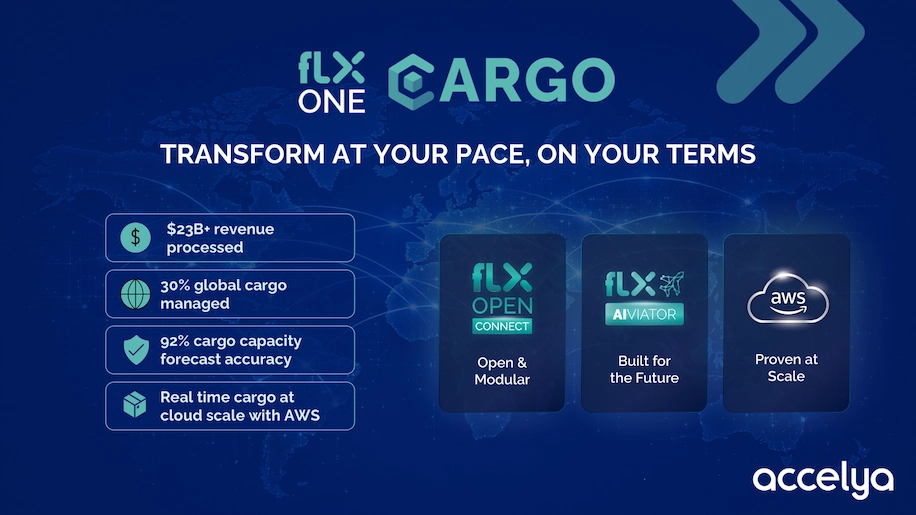
This is the reason why FLX ONE Cargo, Accelya’s open and modular cargo platform, was created.
Built as an AI-native, cloud-native architecture, it allows airlines to transform their cargo technology at their pace, and on their terms – evolving capabilities while maintaining operational stability.
FLX ONE Cargo is built on the proven FLX ONE technology foundation that powers Accelya’s passenger retailing platforms. This gives the airlines to leverage a shared, enterprise-grade architecture across all domains of passenger and cargo, while respecting the distinct operational and regulatory requirements of each business.
Because operational excellence is not about optimizing individual systems.
It’s about enabling the entire airline operation to move with speed, resilience and intelligence.

 Press Releases

 Whitepapers